
Blog · Fuel cards
Fuel card reconciliation: how to check your statements and spot misuse
By Raimondas Ivanovas, founder of vanstamp · · 10 min read
A fuel card statement lists every fill: the date, the site, the product, the litres and the amount. What it can't tell you is whether each fill went into the right van, for work. Fuel card reconciliation is checking each line against what your drivers recorded, and asking about the ones that don't add up.
This guide shows how to do it step by step, the ten signs of misuse worth checking on every statement, what to do when a line doesn't add up, and how to stop it happening in the first place. There's a free spreadsheet that flags the lines for you.
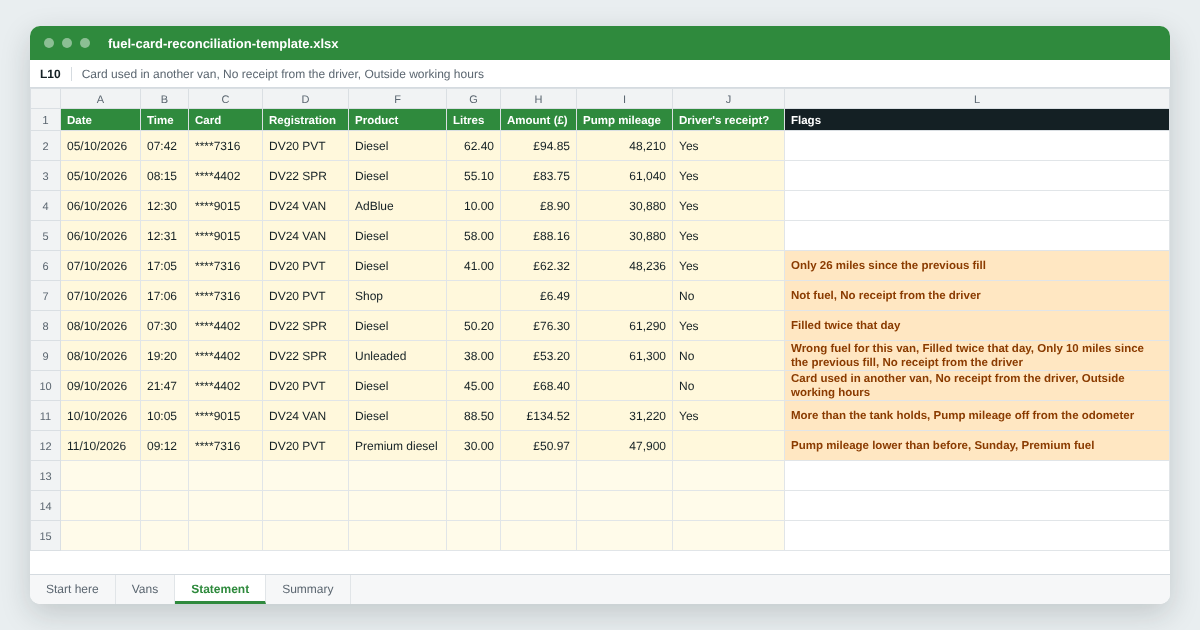
Free fuel card reconciliation spreadsheet
List your vans, paste your statement, and it flags the lines worth a question: more than the tank holds, the wrong fuel, the card used in another van, two fills in a day, too few miles between fills, pump mileage that doesn't add up, shop items, fills outside working hours and premium fuel. A summary adds up litres, AdBlue and spend per van. Works in Excel 2019 or later, Microsoft 365, Google Sheets and LibreOffice.
Download the spreadsheetWhat fuel card reconciliation is
It means matching each line on your fuel card statement to a fill you can account for: a receipt, a fuel stop the driver recorded, or a van that was out working that day. Every line should answer four questions:
- Which van did the fuel go into?
- Who was driving it?
- Was it the right fuel, in an amount the van could take?
- Was it for work?
Most lines answer all four in seconds. The point is to find the few that don't, while the driver still remembers the day.
It matters for your figures too. Fuel is one of the biggest running costs of a van, and if nobody checks the statement you can't trust the cost per van or its miles per gallon.
What you need before you start
- The statement, as a file. Many providers let you download your transactions as a CSV or Excel file from their online account, which is much easier to work with than a PDF.
- A list of your vans. Registration, fuel type, tank size, and which card is kept in which van (or held by which person).
- Drivers' receipts or fuel stop records for the same period, ideally with the odometer reading.
- Who had which van each day. Shifts, a rota or a diary, plus holidays and days off.
The last one is the one most small fleets don't have written down, and it's the one you'll need most when a line doesn't add up.
How to reconcile a statement, step by step
- Check the cards. Every card on the statement should be one of yours and still in use. A card you cancelled, or one you don't recognise, needs a call to your provider today, not next week.
- Match each line to a receipt or fuel stop. Same van, same day, and the litres or the amount agreeing. Tick it off. A line with no receipt isn't automatically wrong, but it's the first thing to ask about.
- Check the van. If the statement shows a registration, is it the van that card belongs to? A card kept in one van shouldn't be paying for another vehicle.
- Check what was bought. Diesel for a diesel van, petrol for a petrol one. AdBlue is normal for diesel vans that use it, but keep it apart from fuel in your totals: it isn't fuel, and counting it as fuel makes miles per gallon look worse than it is. Shop items, car washes and oil should only be there if your policy allows them.
- Check the litres against the tank. No single fill should be more than the tank holds, plus a small margin, because a brimmed tank takes a little more than its official size.
- Check the mileage. If drivers key the mileage in at the pump, compare it with the odometer reading from the receipt or photo, and with the previous fill. It should go up, by a sensible amount, every time.
- Check the day and time against who was working. A fill on a day off, on holiday or in the middle of the night needs an explanation.
- Total it up per van. Litres, AdBlue and spend for each van, and miles per gallon over the month if you have the mileage. A van that suddenly needs more fuel for the same work is worth a look.
- Write down what you decided. For each line you questioned: explained (and how), asked the driver, or confirmed misuse. You'll want that record if it happens again.
Do it every time a statement arrives, not once a quarter. A driver can explain a fill from last Tuesday; three months later nobody can, and you can't tell an honest mistake from a habit.
10 signs of fuel card misuse
These are the patterns worth checking on every statement. The free spreadsheet flags most of them for you.
- More litres than the tank holds. The classic sign of filling a can or a second vehicle at the same time.
- The wrong fuel for the van. Petrol on the card of a diesel van usually means it went into a car.
- The card used for another vehicle. A registration that isn't the card's van, or isn't one of your vans at all.
- Filling up again too soon. Two fills in a day, or a fill after only a few miles, when the van couldn't have used the first one.
- Fills on days off. Weekends, holidays and sick days, when the van wasn't working.
- Odd hours and odd places. Late at night, or at a site nowhere near the day's work or the driver's way home.
- Mileage that doesn't add up. Pump mileage lower than last time, the same number every time, a suspiciously round number, or far from the odometer.
- Extras on the card. Shop items, snacks, car washes, oil and screen wash. Some may be allowed; all should be on purpose.
- Premium fuel. Super unleaded or premium diesel costs more per litre, and most vans run perfectly well without it.
- Miles per gallon falling for no reason. If a van needs noticeably more fuel for the same work, either something's wrong with the van or the fuel isn't all going into it.
One flag on its own proves very little. A pattern does: the same card, the same driver, the same kind of line, week after week.
Lines that look wrong but aren't
Most lines that don't add up have an ordinary explanation. Before asking anyone, check whether it's one of these:
- Vans swapped for the day. The driver took another van and used its card, or kept their own card with them.
- A split payment. Some cards limit how much one transaction can be, so a full tank shows as two lines a minute apart.
- AdBlue at the same stop. Two lines at the same time and site, one of them AdBlue, is normal.
- Topping up before a long job. A fill on Friday afternoon and another on Monday morning before a long run.
- A typo at the pump. Drivers key the mileage in a hurry, and one missing digit makes the van look like it went backwards.
- The wrong card picked up. Two vans parked side by side, or two cards in the same office drawer.
Asking first, rather than accusing, keeps the honest majority of your drivers on side, and usually gets you the answer in a minute.
When a line doesn't add up
- Ask the driver, soon, with the details: date, time, site, litres and amount. “Can you help me with this one?” gets a better answer than “explain yourself”.
- Write down the answer, and whether it explains the line.
- Look at the bigger picture. Check the same card and driver over the last few months. One odd line is usually a mistake; a pattern is a problem.
- If it's misuse, cancel or replace the card, and follow your disciplinary procedure. Take advice before deciding what happens next.
Getting the money back
GOV.UK says an employer can't take money out of someone's pay unless the law requires it, their contract allows it or they've agreed in writing, and a deduction can't normally take their pay below the National Minimum Wage, even if they agree (deductions from pay). So the time to agree how misused fuel is paid back is when the card is handed over, in your fuel card policy.
Private fuel and tax
Private fuel can also be a tax matter. If you provide fuel for private journeys in a company van, it can be a taxable benefit: for the 2026 to 2027 tax year HMRC's standard value for private van fuel is £798, on top of £4,170 for private use of the van itself, reported on a P11D with Class 1A National Insurance (company vans: work out the value). The fuel value is reduced if the employee pays you back for all their private fuel. Vans used only for business journeys, or for insignificant private journeys such as a slight detour on the way to work, are exempt (what's exempt). Your accountant can tell you how this applies to your vans.
A fuel card policy and card controls
Most misuse is prevented by two things: everyone knowing the rules, and everyone knowing the statement is checked. A short written policy covers the first. It should say:
- which vehicle each card is for, and that it's for that vehicle only
- what it can buy: fuel, AdBlue, and anything else you allow, such as screen wash
- that the PIN is never written on the card or shared
- that the correct mileage is keyed in at the pump every time, if the card asks for it
- that the receipt is kept, or the fill recorded, the same day
- that a lost or stolen card is reported straight away
- whether private use is ever allowed, and how it's paid back
- what happens if the card is misused, including paying the money back
Have each driver sign it when they're given a card, and keep the signed copy.
Then ask your fuel card provider which controls your cards have. Common ones are:
- fuel only, or fuel and AdBlue only, so shop items are declined
- the van's registration on the card, so it's tied to one vehicle
- a mileage prompt at the pump
- limits on spend or litres per transaction or per day
- limits on the days or times the card works
Not every provider offers all of these, but switch on the ones yours does: a declined transaction is better than a line you have to chase.
VAT, tax and keeping records
- VAT. If you're VAT registered, you can usually reclaim the VAT on fuel for business journeys. When some fuel is used privately, HMRC's VAT Notice 700/64 (section 9) sets out the options, such as using detailed mileage records to separate business from private mileage, or claiming no VAT on fuel at all.
- Private fuel as a benefit. See private fuel and tax above.
- Records. Keep the statements, the receipts and your notes on every line you questioned. A limited company must keep its records for 6 years from the end of the last company financial year they relate to (GOV.UK); sole traders for at least 5 years after the 31 January submission deadline of the tax year (GOV.UK).
This guide isn't tax or legal advice; for your own situation, ask your accountant.
Spreadsheet or software?
The free spreadsheet does the checking once the lines are in. List your vans with their tank sizes and cards, paste the statement, mark each line Yes or No against the receipts, and the Flags column tells you which lines need a question and why. You choose the tank margin, the working hours, whether weekends count, and the fewest miles you expect between fills.
Its limits are the ones every spreadsheet has: someone still has to collect the receipts, type in the odometer readings and work out who had which van.
That's the part VanStamp takes over. At each fuel stop the driver photographs the pump and the odometer, and VanStamp reads the litres, the amount and the mileage from the photos, so there's nothing to type and nothing to lose.
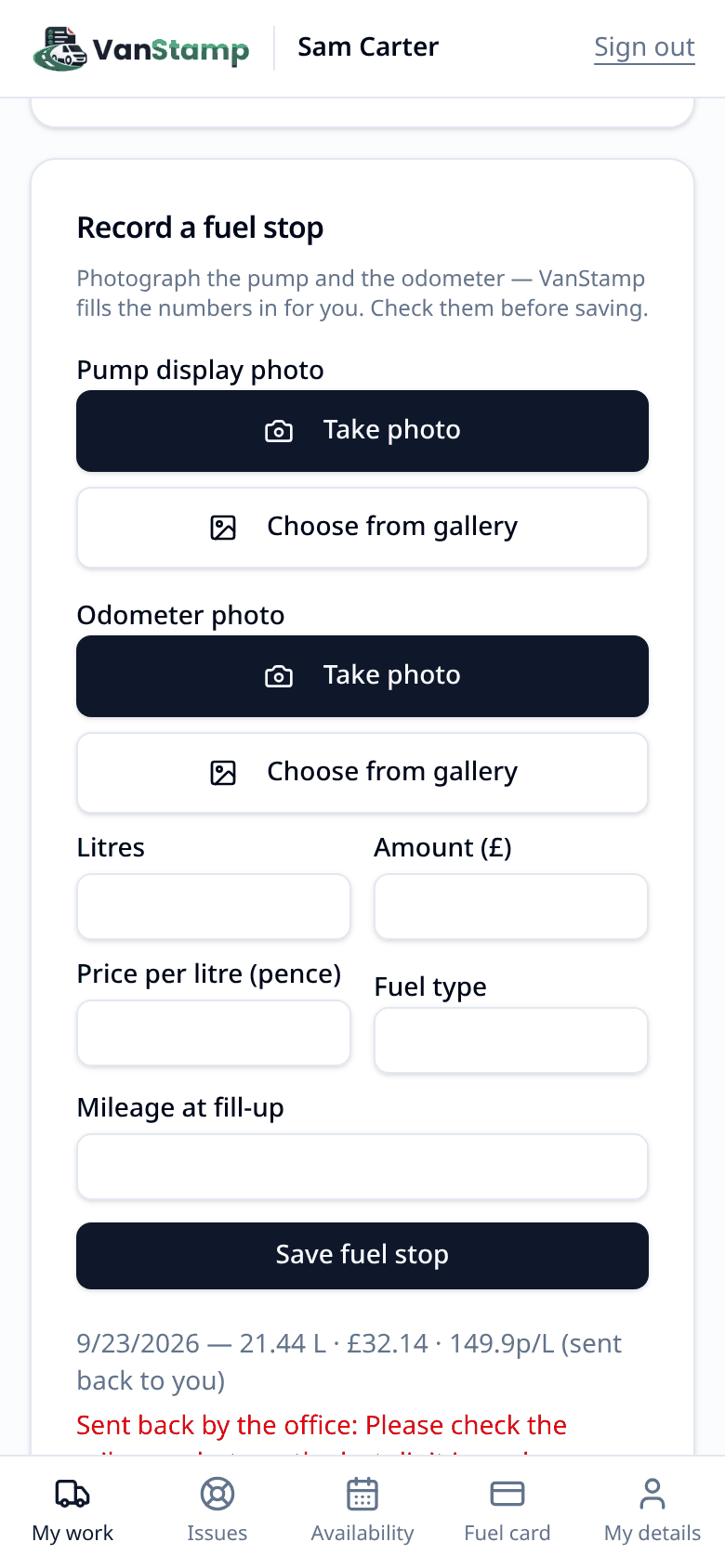
You import the fuel card statement as a CSV or PDF file, and each line is matched to a driver's fuel stop automatically: the same van (or the card's last four digits), within a day, with the litres or the amount agreeing. Matched lines become verified spend, and AdBlue is only ever matched to AdBlue. VanStamp also keeps a dated record of which van every card was in and who had each van, so “who was driving?” always has an answer.
Then the Check these tab lists every line that doesn't add up, with the reason: the card used for a vehicle that isn't its van or the card holder's, no fuel stop photo within two days, pump mileage far from the odometer photo or lower than the van's last reading, more litres than the tank holds, no shift on that van at that time, the driver booked off that day, a second fill the same day or too few miles since the last one, the wrong fuel, and shop items or a car wash. For each line you mark it explained, ask the driver (who answers in their app), or confirm misuse, and every decision stays on record.
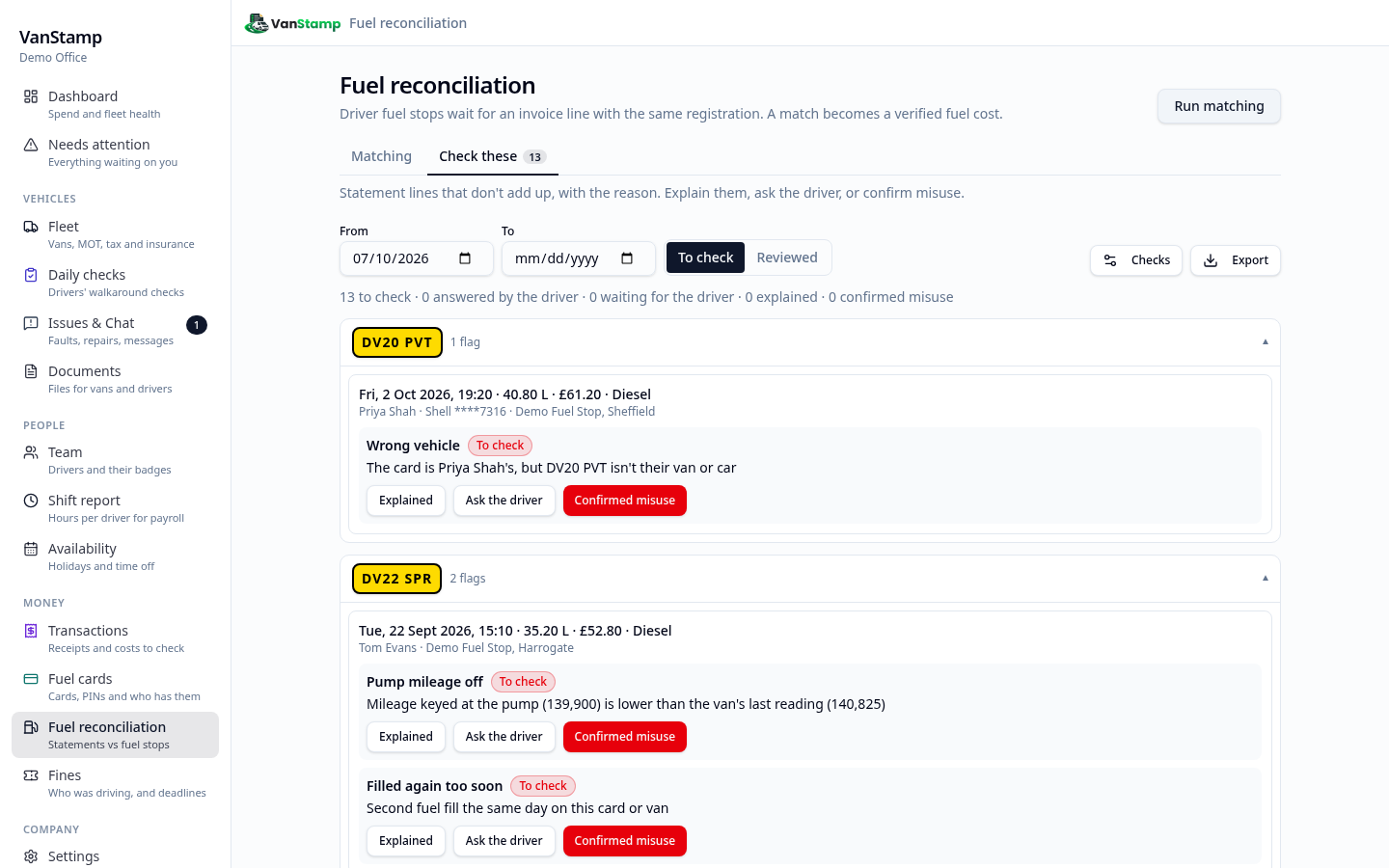
Statement matching is on every plan, and the Check these list comes with the Business plan and above. For the rest of running a small fleet, from daily checks to fines, see our van fleet management guide.
Questions people ask
What is fuel card reconciliation?
Checking each line of your fuel card statement against the fills your drivers recorded, so every litre is matched to a van, a driver and a reason. Lines with no match, or that don't add up, are the ones to ask about.
How often should I reconcile fuel card statements?
Every time a statement or invoice arrives. The sooner you ask about a line, the more likely the driver remembers the day, and the sooner a lost or copied card is stopped.
What counts as fuel card misuse?
Using a company fuel card for anything the company hasn't allowed: fuel for a personal car, filling cans, shop items, or fuel for private journeys that isn't paid back. Your fuel card policy is what draws the line, so write it down.
Can I take misused fuel out of an employee's wages?
Only if the law requires it, their contract allows it or they've agreed in writing, and a deduction can't normally take their pay below the National Minimum Wage, even if they agree (GOV.UK: deductions from pay). Put it in your fuel card policy and contracts before there's a problem, and take advice before you deduct anything.
Can a van take more fuel than its tank size?
A little. The filler neck and pipe hold some fuel too, and filling on after the pump clicks off adds more, so a fill a few litres over the handbook figure isn't unusual. A fill well over it is a question.
How long should I keep fuel card statements?
As long as your other business records: 6 years from the end of the last company financial year they relate to for a limited company (GOV.UK: company records), and at least 5 years after the 31 January submission deadline for sole traders (GOV.UK: self-employed records).
Does VanStamp connect directly to fuel card providers?
No. You import your statement as a CSV or PDF file, and VanStamp matches it to your drivers' fuel stops.