
Blog · Fleet management
Van fleet management: a practical guide for small UK fleets
By Raimondas Ivanovas, founder of vanstamp · · updated · 12 min read
Running vans is simple until it isn't. With two or three you can keep it all in your head. By five or ten, with drivers on different shifts, fuel cards in glove boxes and MOT dates spread across the year, things start to slip: a check that wasn't done, a receipt that never turned up, a fuel card line nobody can explain, a speeding notice for a van nobody remembers driving.
This guide covers what a UK business running a small van fleet needs to keep on top of: daily checks, MOT and tax, mileage, fuel and fuel cards, fines and costs. Where the law is involved it links to the official GOV.UK guidance. It ends with what to look for in fleet software and how VanStamp handles each part.
What van fleet management involves
For a small fleet it comes down to answering a handful of questions quickly:
- Which vans are on the road today, and who has each one?
- Was every van checked before it went out, and what faults were found?
- When are the MOT, tax, insurance and service due on each van?
- What did each van cost this month in fuel, repairs and everything else?
- Does the fuel card statement match the fuel your drivers actually bought?
- Who was driving when a speeding or parking ticket arrives?
If any of these takes more than a minute to answer, your records are working against you. The rest of this guide takes them one at a time.
Daily walkaround checks and defects
The person driving a van is responsible for making sure it's safe to drive. DVSA's guidance on van daily walkaround checks recommends a check before each journey: inside the cab (mirrors and glass, wipers and washers, dashboard warning lights, steering, horn, brakes, seats and belts) and outside (lights and indicators, fluids and leaks, battery, bodywork and doors, tyres and wheels, the load and how it's secured, AdBlue, exhaust, number plates, and any tow bar or tail lift).
The stakes are real. GOV.UK warns that using a van in a dangerous condition can mean an unlimited fine, and drivers can get 3 penalty points for each tyre that isn't safe and legal. If your business holds an operator's licence, DVSA says you should record each day's check and any defects, including “nil” defects when nothing is wrong.
A check is only useful to the office if it was done on the van it says, at the time it says, and any fault reaches someone who can decide whether the van goes out. A photo turns “it was fine this morning” into something you can show, not just say.
How VanStamp handles daily checks
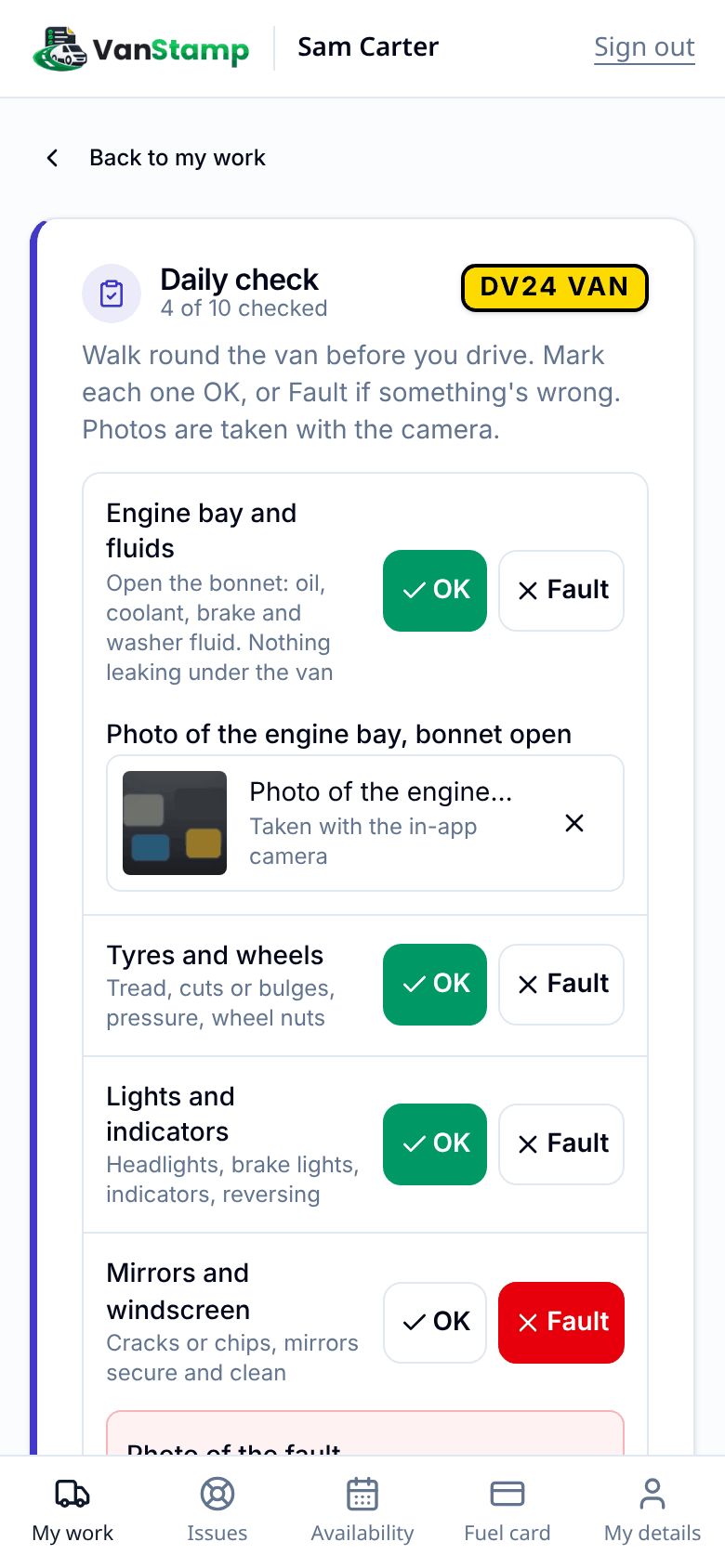
Drivers do the check on their phone: ten items, each marked OK or Fault, with a photo of the engine bay every time and a photo of any fault. Photos are taken with the camera there and then, never picked from the gallery. A fault reaches the office as an issue straight away, and you can require the check before a driver can start a shift. See the daily check in How it works, or our van daily walkaround check guide for every item and a free printable sheet.
MOT, tax, insurance and servicing
In Great Britain a van needs its first MOT by the third anniversary of its registration, then every year (getting an MOT). Driving without a valid MOT can mean a fine of up to £1,000. Northern Ireland has its own rules.
Check which MOT class each van needs. Vans up to 3,000kg design gross weight are tested as class 4; vans from 3,001kg to 3,500kg need a class 7 test (MOT inspection manual). Vans that look alike can fall either side of the line, so check the weight on the plate rather than the model name.
Road tax, insurance renewals, breakdown cover and service intervals are the other dates that catch fleets out. Two GOV.UK services are worth bookmarking: check MOT history and check vehicle tax.
How VanStamp handles dates
Every van has its MOT, insurance, road tax, breakdown cover and service dates. Anything due soon or overdue goes on one Needs attention list, you choose how early reminders start, and drivers are warned if the van they're driving is out of date. Upload an insurance certificate and VanStamp suggests the insurer, policy number, end date and the vans it covers, for you to check and save.
Mileage, and who had which van
Mileage tells you how hard each van is working, when it's due a service and what it costs per mile. The simplest reliable method is a reading at the start and end of each shift, with a photo of the odometer, so nobody has to type a number or remember one.
Just as important is knowing who had which van, and when. When a fine, a dent or a fuel card query turns up a week later, “who was driving at 10:05 on Monday?” needs an answer you can stand behind.
How VanStamp handles mileage
Drivers start and end each shift with an odometer photo, and VanStamp reads the number from the photo. Readings that look wrong, such as lower than last time or an unlikely jump, are flagged for the office rather than rejected, and the van's mileage updates itself. Every change of van is kept, so VanStamp can tell you who had a van at any moment: from the shift first, then a van switch that day, then the van they were given. Shift times can be exported for payroll; it isn't a tachograph or a record of legal driving hours.
Fuel, receipts and fuel cards
Fuel is usually the biggest running cost after the van itself. For each fill you want the date and time, the van, the driver, the litres, the amount, the fuel type and the odometer reading, with the receipt or a pump photo. Keep AdBlue separate: it isn't fuel, and counting it as fuel makes fuel economy look worse than it is.
If you use fuel cards, the statement is your most complete record of what was bought, but it only tells you which card was used, not who used it or why. Fuel card reconciliation means checking each line of the statement against what your drivers recorded.
How VanStamp handles fuel
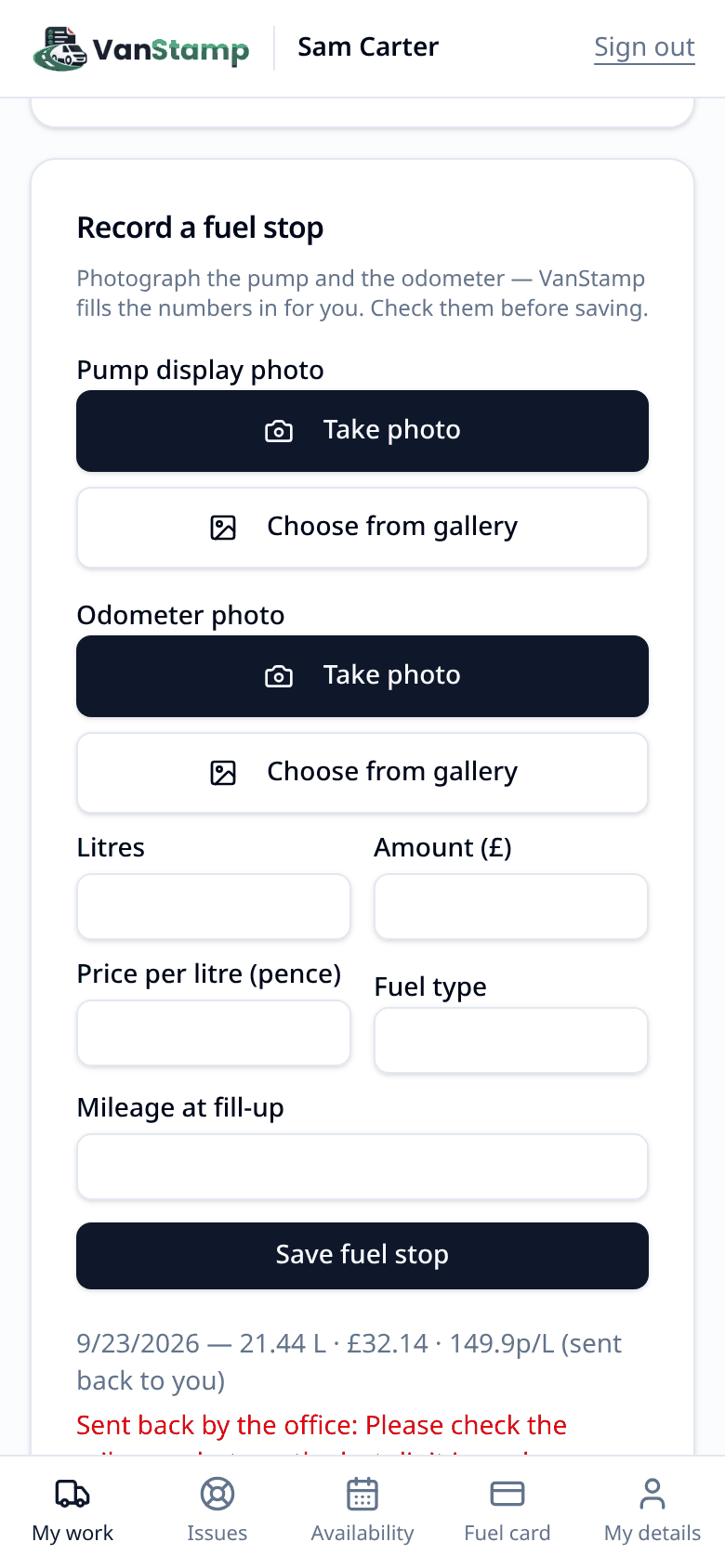
At a fuel stop the driver photographs the odometer and the pump, and VanStamp reads the figures. Receipts are read the same way: total, VAT, date and supplier. Import your fuel card statement as a CSV or PDF, and each line is matched to a driver's fuel stop by registration (or the last four digits of the card), within a day, with the litres or amount agreeing. Matched lines become verified spend; unmatched ones are flagged. VanStamp works from statement files; it doesn't connect live to fuel card providers.
Spotting fuel card misuse
Most fuel card problems are honest mistakes, like the wrong card used in the wrong van or a lost receipt. Still, a few patterns are worth checking on every statement:
- The card used for a van it doesn't belong to.
- More litres than the van's tank can hold.
- Two fills on the same day, or very few miles since the last fill.
- A fill when nobody was on shift in that van, or when the driver was booked off.
- Petrol bought for a diesel van, or the other way round.
- Shop items or car washes on a fuel card.
- Mileage keyed in at the pump that doesn't match the odometer photo.
A line that doesn't add up isn't proof of misuse. It's a question to ask, and the driver often has a simple answer. For the full step-by-step check, what to do when a line doesn't add up and a free spreadsheet that flags the lines for you, see our guide to fuel card reconciliation.
How VanStamp handles fuel card checks
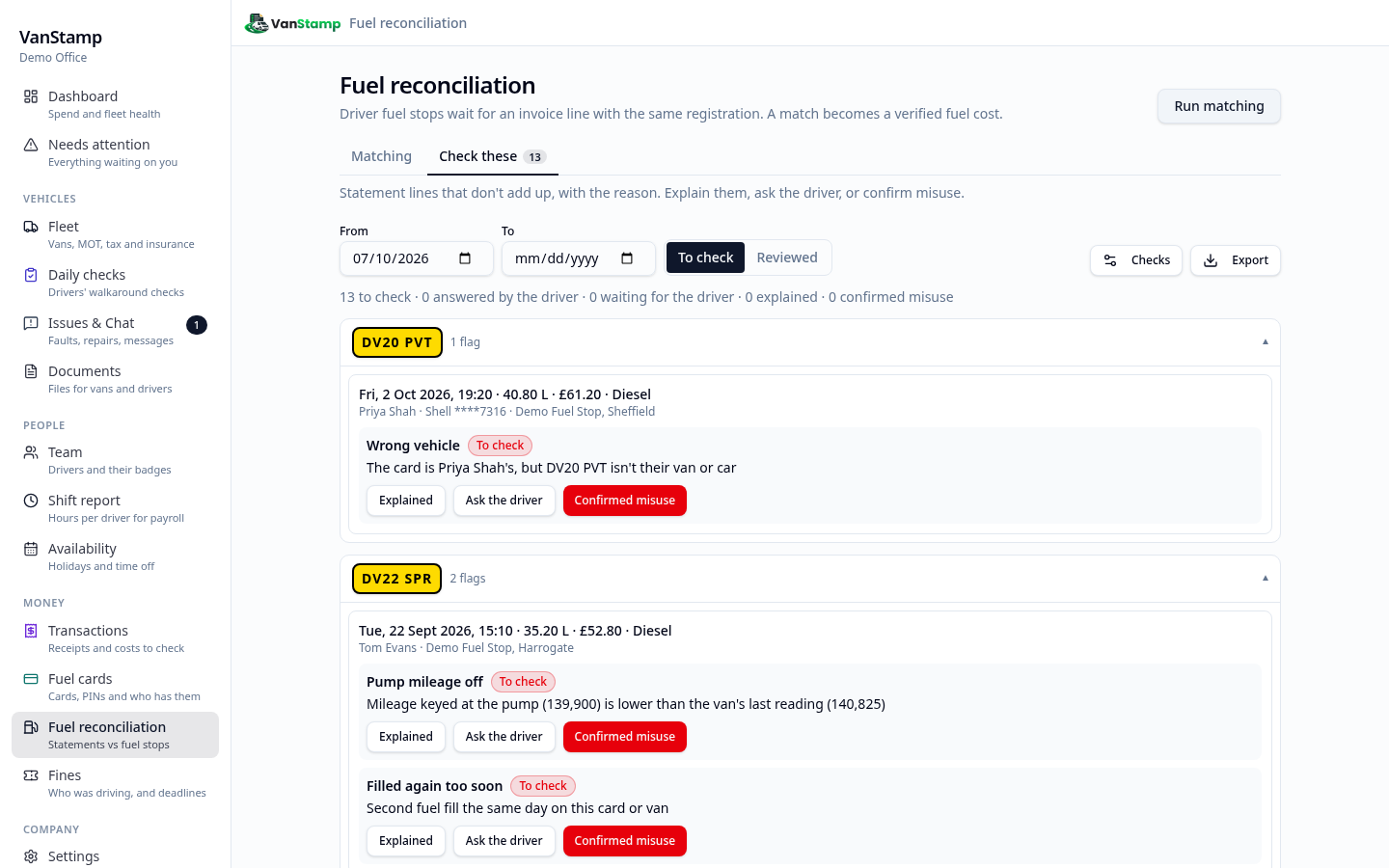
After each statement, the Check these tab lists every line that doesn't add up, with the reason. For each one you mark it explained, ask the driver (who answers in their app) or confirm misuse, and every decision is kept on record. Fuel card checks come with the Business plan and above.
Speeding and parking fines: who was driving?
When a company van is caught speeding, the notice goes to the registered keeper, usually the business. GOV.UK says a Notice of Intended Prosecution is sent within 14 days, together with a Section 172 notice, and you must return the Section 172 notice within 28 days telling the police who was driving (speeding penalties). Ignore it and you may have to go to court.
Parking and bus lane tickets have their own deadlines, often with a reduced amount for paying early. Either way you need to know who had the van at that exact time, and you need someone keeping an eye on the dates. Our guide to company van speeding fines goes through it step by step, with a free van driver log.
How VanStamp handles fines
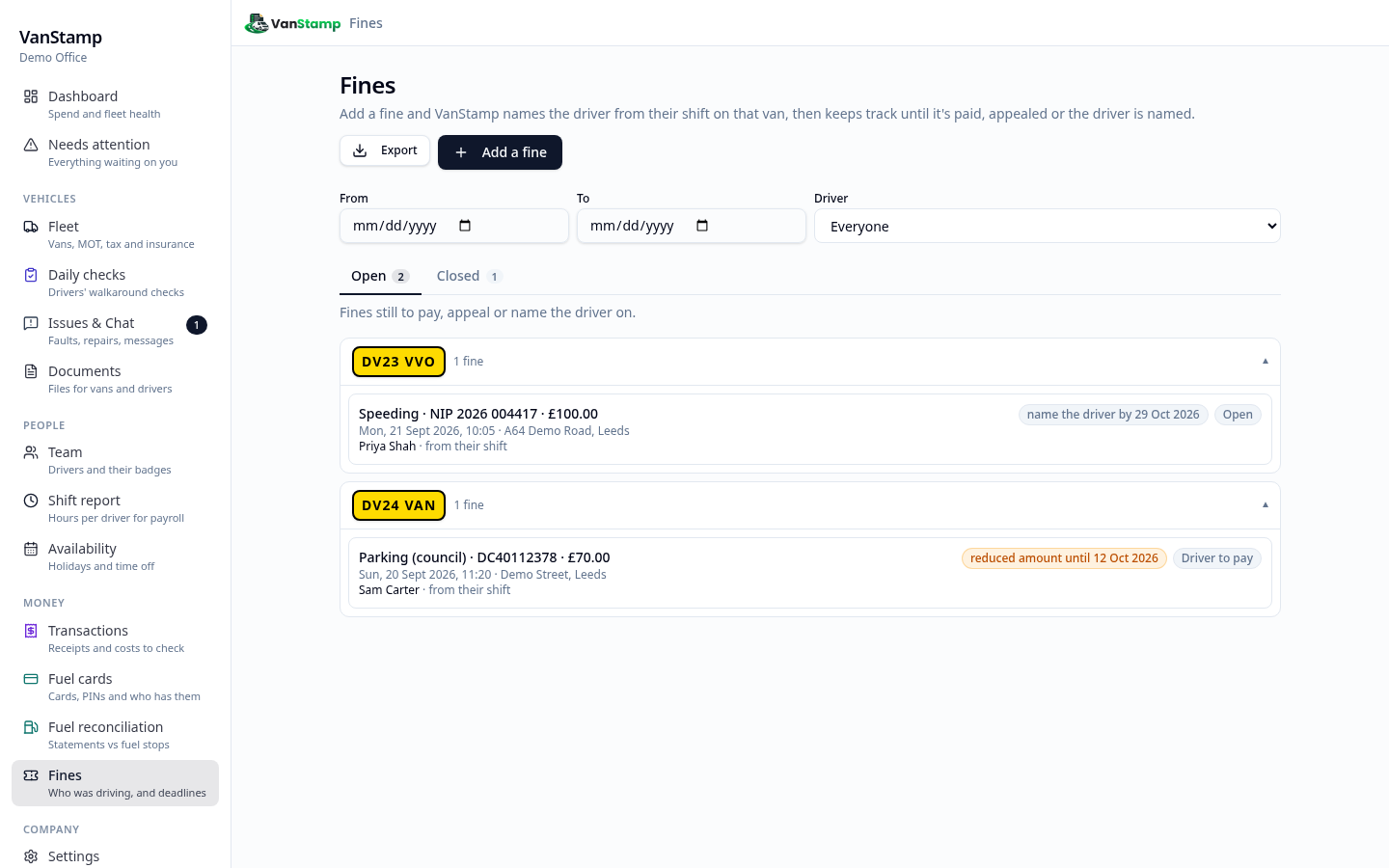
Add a fine and VanStamp names the driver from their shift on that van at that moment, with the odometer photos and that day's daily check as evidence. It tracks the deadlines (reduced amount, naming the driver, paying) and puts them on Needs attention from a week before. Fines come with the Business plan and above.
The real cost of each van
Fuel is only part of what a van costs. Repairs, tyres, servicing, insurance, tax, breakdown cover, parking and fines all add up, and they're easy to lose in a single monthly total.
Fuel cost per mile is a useful first number. If a van uses £240 of fuel over 800 miles:
£240 ÷ 800 miles = £0.30 per mile
Work it out over a period between two reliable odometer readings, not fill by fill, because one partial fill or missed reading can make a single figure wildly wrong.
Then look at cost per van, not just the fleet total. One van that's always at the garage or always thirsty can hide inside a healthy-looking monthly figure.
VanStamp's dashboard shows spend per van and per category, counting only verified costs: receipts the office has checked and fuel card lines matched to a fuel stop.
Do you need GPS tracking?
Not for any of the above. Tracking tells you where a van is right now. Fleet administration is about what happened: checks, mileage, fuel, costs, dates and fines. Some businesses need live locations and route data; many just need reliable records, and drivers tend to accept record-keeping more readily than tracking.
VanStamp doesn't track vehicles. It records what drivers log, and it removes location data from every photo before storing it.
When spreadsheets stop working
A spreadsheet is a perfectly good start for two or three vans. It stops working when the information lives in several places: services in one sheet, fuel receipts in email, checks on paper, insurance in a folder, and the person who knows how it all fits together is on holiday.
Before you switch, pin down the actual problem. It's usually one of these: missing evidence, typing the same thing twice, nobody clearly responsible for a task, or no single list of what needs doing. Whatever you move to should fix that without adding steps for your drivers.
What to look for in fleet software
The right fleet management software for a small business depends on your vans, your drivers and what goes wrong most often. These are the questions worth asking:
1. Drivers will actually use it
If the driver app takes more than a few taps, records stop arriving. Ask for a trial and give it to your least patient driver.
2. Evidence, not just entries
Photos taken at the time, on the van they're about, beat numbers typed in later. Check whether photos can come from the gallery.
3. Daily checks and defects
Can a fault stop a van going out, and does the office hear about it straight away?
4. Fuel card statements
Can you import your statement and see which lines match a driver's fuel stop and which don't? Does it point out lines worth questioning?
5. Who had which van
When a fine or a damage report turns up a week later, can it tell you who was driving at that moment?
6. Dates and reminders
MOT, tax, insurance, breakdown cover and servicing for every van, on one list, with reminders you can set.
7. Exports your accountant can use
Clean CSV for spreadsheets and a PDF with your company details.
8. Price per van
Compare the price against the number of vans and office logins you need now and in a year. Don't pay for telematics you won't use.
How VanStamp does it
VanStamp is van fleet software for small UK fleets: a driver app that works in the phone's browser, and an office side that puts everything in one place.
- Daily walkaround checks with camera-only photos, and faults reported straight to the office.
- Shifts, fuel stops and receipts recorded by photo, with the figures read for you.
- Fuel card statements matched to fuel stops, and the lines that don't add up listed with the reason.
- Fines matched to the driver on shift, with every deadline tracked.
- MOT, tax, insurance, breakdown and service dates on one Needs attention list.
- Breakdowns and issues in one thread with the driver, and vans marked off the road until they're fixed.
- A full history for every van, and CSV or PDF exports for your accountant.
- Several companies on one login, if you run more than one.
Plans start at £12.00 a month for one van, and every plan starts with a 14-day free trial on the full Pro plan, no card needed. See pricing or walk through how it works.
VanStamp keeps your records and points out problems. Keeping vans roadworthy and meeting the rules that apply to your business still rests with you and your drivers.
Questions people ask
Do vans need a daily walkaround check?
The driver is responsible for making sure the van is safe to drive, and DVSA recommends a walkaround check before each journey. If your business holds an operator's licence, DVSA says you should record the checks and any defects.
Which MOT class is a van?
Vans up to 3,000kg design gross weight are class 4, and vans from 3,001kg to 3,500kg are class 7 (MOT inspection manual). The first MOT is due by the third anniversary of registration in Great Britain.
Who has to name the driver on a speeding notice for a company van?
The registered keeper, usually the business. GOV.UK says you must return the Section 172 notice within 28 days, telling the police who was driving (speeding penalties).
What is fuel card reconciliation?
Checking each line on your fuel card statement against the fuel your drivers recorded. Lines with no matching fuel stop, or that don't add up, are the ones to ask about.
Can I manage a van fleet without GPS tracking?
Yes. Checks, mileage, fuel, costs, dates and fines are all record-keeping, and none of them need live tracking. VanStamp doesn't track locations and removes location data from every photo.
Does VanStamp connect directly to fuel card providers?
No. You import your fuel card statement as a CSV or PDF file and VanStamp matches it to your drivers' fuel stops.
How much does VanStamp cost?
Plans start at £12.00 a month for one van (Solo), and every plan starts with a 14-day free trial on the full Pro plan, with no card needed.
Where to start
Pick the question from the top of this guide that takes you longest to answer today, and fix that first. For most small fleets it's either fuel card lines nobody can explain or not knowing who had a van when a ticket arrives.
If you'd like to see how VanStamp handles it, the trial takes a couple of minutes to start, and your drivers only need their phone.