
Blog · Vehicle checks
Van daily walkaround check: what to check, and a free printable checklist
By Raimondas Ivanovas, founder of vanstamp · · 8 min read
A walkaround check is the few minutes a driver spends looking over a van before setting off: lights, tyres, mirrors, fluids, the load. It's the cheapest way to catch a fault before it becomes a breakdown, a roadside prohibition or penalty points.
This guide goes through every item DVSA lists for vans, explains what to do when something's wrong, and covers what to record if your business has an operator's licence. There's a free printable weekly sheet you can keep in each van.
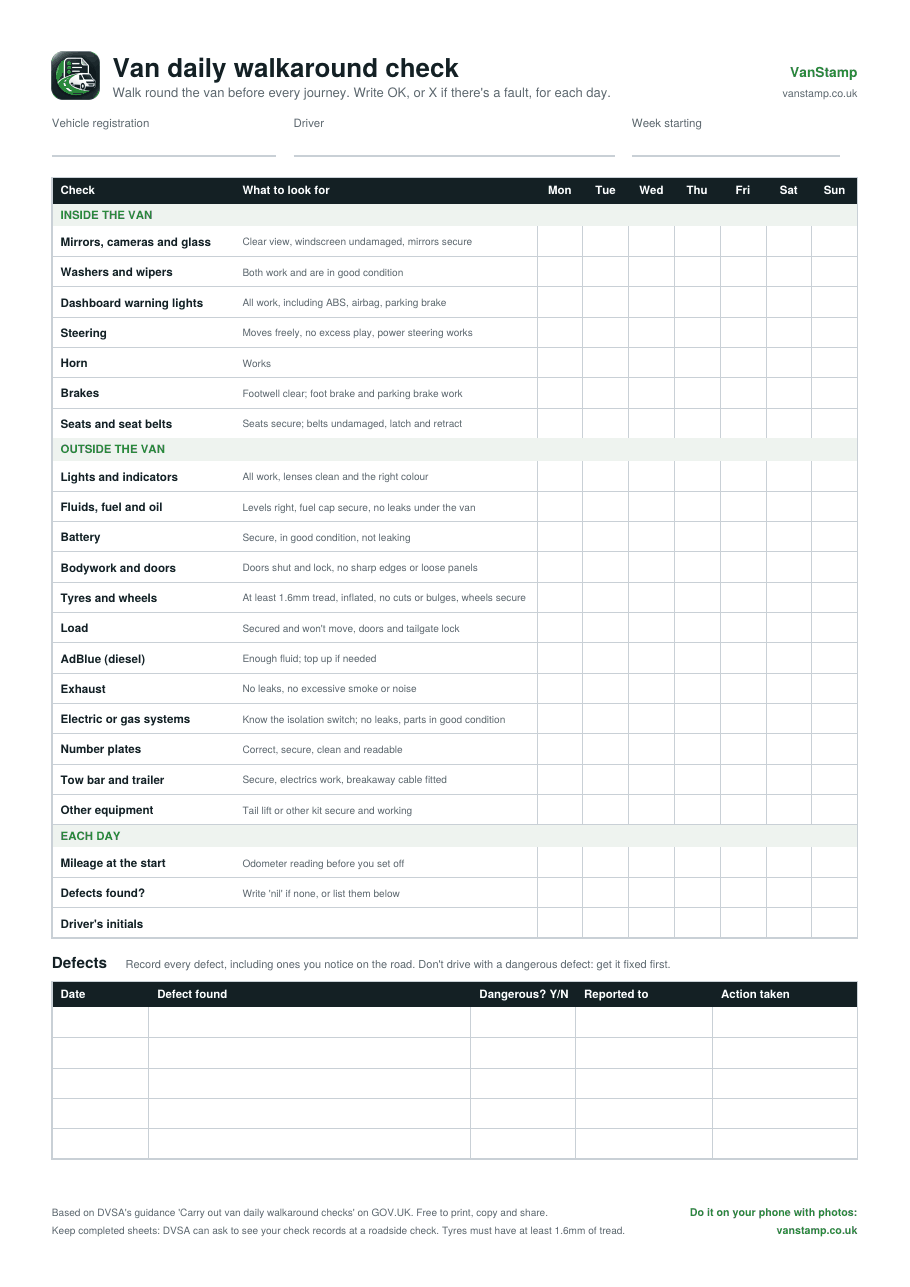
Free printable check sheet
One A4 page for a week: every DVSA check item with a box for each day, the start mileage, the driver's initials and a table for defects. Print it, keep a pad in each van, and copy it as much as you like.
Download the PDFWho has to do a walkaround check?
The driver. GOV.UK puts it simply: you're responsible for making sure your van is safe to drive, and DVSA's guidance on van daily walkaround checks says to do a walkaround check before your journey. That applies whether it's your own van or a company one, and whether you drive for yourself or an employer.
The consequences of skipping it fall on the driver too. Police and DVSA can stop and check vans, and if a van is dangerous DVSA can stop it being used until it's fixed. Using a van in a dangerous condition can mean an unlimited fine and even a prison sentence, and each tyre that isn't safe and legal can cost 3 penalty points.
For the business, a check that's done properly and written down is also your evidence that you take roadworthiness seriously if something does go wrong.
Inside the van: 7 checks
Start in the cab with the engine off and the keys in.
- Mirrors, cameras and glass. Nothing blocking your view or the area the wipers clear. The windscreen is undamaged, mirrors are in place, undamaged and secure, and any cameras work.
- Washers and wipers. Both work and are in good condition.
- Dashboard warning lights. They all work, including ABS, airbag, EBS, EPS, ESC, full beam and parking brake. Turn the ignition on and watch them come on and go out.
- Steering. The wheel turns freely without jamming or too much play, power steering works, and the column doesn't move about.
- Horn. It works.
- Brakes. The footwell is clear of rubbish and nothing can roll under the pedals. The foot brake and parking brake work without too much travel.
- Seats and seat belts. Seats are secure. Belts aren't cut or frayed, latch properly, and retract and stow.
Outside the van: 12 checks
Then walk all the way round, including the back and both sides.
- Lights and indicators. Every light and indicator works, lenses are fitted, clean and the right colour, and the brake lights come on when you press the brake. Get someone to help, or check reflections in a window.
- Fluids, fuel and oil. Brake fluid, coolant, engine oil, power steering fluid and washer fluid are at the right level. The fuel cap is secure, and nothing is leaking under the van.
- Battery. Secure, in good condition and not leaking.
- Bodywork and doors. Doors close properly and stay shut, with no damage, sharp edges or loose panels.
- Tyres and wheels. Wheels and trims are secure, tread is legal, tyres are properly inflated, and there are no deep cuts, bulges or visible cords. More on this below.
- Load. The load is secured and won't move, the right straps or restraints are used, and doors, side boards and tailgate lock.
- AdBlue (diesel vans). There's enough; top it up if not.
- Exhaust. No leaks, no excessive smoke and no unusual noise.
- Electric or gas vans. You know where the isolation switch is, nothing is leaking, and the parts you can see are in good condition.
- Number plates. The right type, secure, clean and readable.
- Tow bar and trailer. The tow bar is secure, the trailer is properly attached with working electrics, and the breakaway cable is fitted.
- Other equipment. Anything specific to the van, such as a tail lift, is secure, undamaged and working.
DVSA publishes its own van driver's daily walkaround check guide too. The printable sheet on this page follows the same list.
Tyres: the check that costs the most points
Tyres are worth a slower look, because each bad one can cost the driver 3 points.
- Tread depth. Cars, light vans and light trailers must have at least 1.6mm of tread across the central three-quarters of the tyre, all the way round (The Highway Code, annex 6). The wear bars moulded into the grooves sit at about that depth: if the tread is level with them, the tyre needs replacing.
- Pressure. Tyres must be inflated to the maker's figure for the load you're carrying. Check them when they're cold, before a journey; warm tyres give a misleading reading.
- Damage. Look for cuts, bulges and any cord showing through, on the outer and inner walls.
- Wheels. Wheel nuts all present and tight, and no damage to the rims.
If you find a defect
DVSA's advice is straightforward:
- If you find something during the check, assess it and report it before you set off.
- If you notice something on the road, stop somewhere safe, assess it and report it.
- A dangerous defect has to be fixed before the van goes any further.
“Dangerous” is a judgement call, so make it easy for drivers to ask. A small chip in the windscreen away from the driver's view can usually be booked in; a tyre with cord showing or brakes that pull hard mean the van stays put. If there's any doubt, the van stays where it is until someone who knows has looked at it.
The person the driver reports to needs to act on it too: book the repair, decide whether the van can be used in the meantime, and tell the next driver.
Recording checks and nil defects
If you drive for a business that holds an operator's licence, DVSA says you should record every defect, whether you found it during the check or noticed it during the journey. Each record should include:
- the van's registration
- the date
- what the defect is
- your assessment of it, for example “dangerous”
- your name
- who you reported it to
Use a form that lists the items checked each day, and write “nil” on days with no defects, so a blank never has to be explained. DVSA can ask to see the record at a roadside check, and you can use DVSA's template or your employer's own system.
Even without an operator's licence, keeping the same kind of record is good practice. It shows the check was done, and it gives you a history for each van when a fault keeps coming back.
Paper sheet or phone?
A paper sheet like the one on this page works, and it's free. Its weak spots are well known: sheets go missing, get filled in at the end of the week from memory, and nobody in the office sees a fault until the pad comes back.
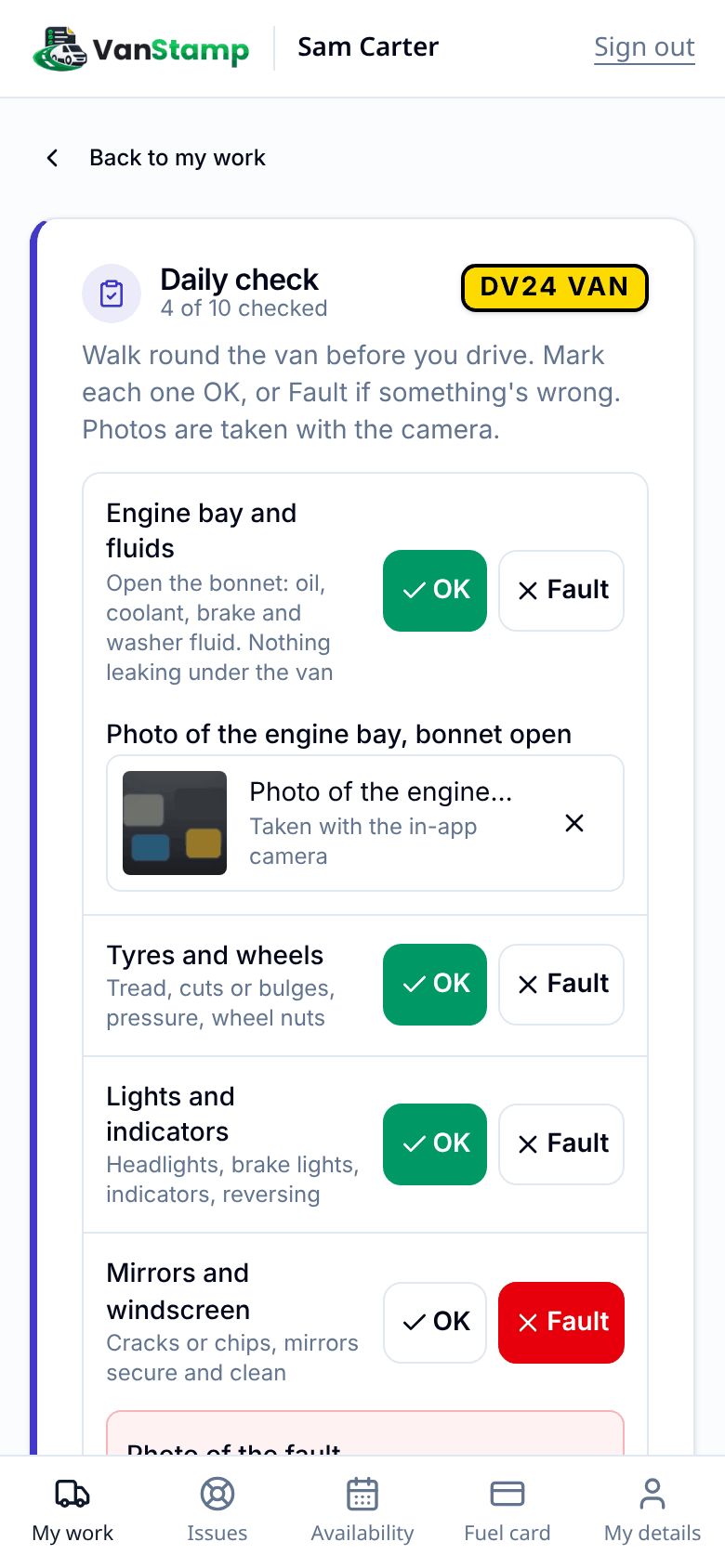
A phone check fixes those. In VanStamp the driver does the daily check on their phone before starting work: ten items, each marked OK or Fault, with a photo of the engine bay every time and a photo of any fault, taken with the camera there and then rather than picked from the gallery. A fault reaches the office as an issue straight away, the check is stamped with the time and the van, and you can require it before a driver can start a shift. The office sees every check on one page and can export them as a PDF with the photos.
Whichever you use, the check only works if it happens every time, and someone acts on what it finds. For the rest of running a small fleet (MOT dates, fuel cards, fines and costs), see our van fleet management guide.
Questions people ask
How often should a van walkaround check be done?
Before every journey, according to DVSA's van daily walkaround checks guidance. In practice that means at the start of the day, and again if someone else takes the van out later.
Is a daily walkaround check a legal requirement for vans?
The driver is legally responsible for the van being safe to drive, and using a van in a dangerous condition is an offence. DVSA's guidance tells van drivers to do a walkaround check before each journey, and drivers working for a business with an operator's licence should record the checks and any defects.
What is a nil defect report?
A check record that says no defects were found. DVSA asks businesses with an operator's licence to record 'nil' on days with no defects, so there's proof the check was done, not just a gap.
Can drivers do the check on an app instead of paper?
Yes. DVSA says you can use its template or your employer's own system. What matters is that it lists the items checked each day, records any defects with the details DVSA asks for, and can be shown if DVSA asks.
What's the minimum tread depth for van tyres?
1.6mm across the central three-quarters of the tread and around the whole tyre, for cars, light vans and light trailers (The Highway Code, annex 6). Drivers can get 3 penalty points for each tyre that isn't safe and legal.
How long does a walkaround check take?
A few minutes once it's a habit. The first few times take longer while drivers learn what to look for, which is why a written list helps.